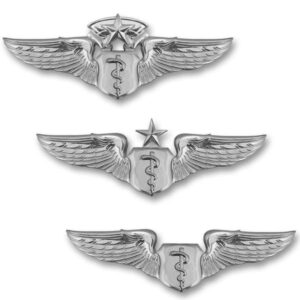

How does one become a USAF Flight Surgeon you may ask?
The recipe is simple.
Step 1: Meet the appropriate licensing requirements to practice medicine.
Step 2: Join the USAF as a commissioned officer.
Step 3: Complete the USAF Aerospace Medicine & Aircrew training requirements.
Below is an article detailing the current aerospace medicine training required of USAF Flight Surgeon candidates, written by none other than the current lead instructor for all of the Aerospace Medicine Primary (AMP) Courses aka "The AMP Daddy", Lt Col Bryant 'THUNDA' Martin:
A BRIEF HISTORY OF THE FLIGHT SURGEON
Since the term "flight surgeon" was coined at Hazelhurst Laboratory on March 11, 1918, and the first three physicians graduated, flight surgeons have been the widget called upon in times of crisis and change. As my AMP Daddy would readily say of the flight surgeon, "Break glass in case of war."

THE HISTORY OF AMP
For those unfamiliar with the current process, AMP has been broken up into four courses of 2-3 weeks duration known as AMP 101, 201, 202, and 301. Going forward, AMP will continue to be a four-course process, with each iteration being 2 weeks long.


AFOM 101: INTRODUCTION TO USAF MEDICINE (2 weeks)

AFOM 101 is the evolution of the previous AMP 101 course with the emphasis built around introducing the new provider to the role of the medical provider in the Air Force Medical Service (AFMS) and the role of the AFMS in the USAF.
AFOM 102: CLINICAL OPERATIONAL MEDICINE (2 weeks)
AFOM 102 brings all of the non-aviation, Air Force occupational skills under one course. These are skills that we have taught and have been expected to master in the field.
AMP 201: ADVANCED CLINICAL AEROSPACE MEDICINE (2 weeks)

AMP 201 has been the bread and butter course for teaching clinical competency for flight medicine since its inception. AMP 201 is limited to a class size of 36 students organized into 6 flights of 6 students each.

AMP 202: AEROMEDICAL AVIATION LABORATORY (2 weeks)

AMP 202 is where flight surgeons get hands-on aviation experience including actual flight training with a local aviation contractor.